
Marathon County Tax Record Fields
Marathon County property tax records tie each parcel to an assessed value, tax years, and its district. They also track payment history. Ascent carries the tax-listing side. It includes the owner of record, address, PIN, an abbreviated description, status tags, and assessment context. The treasurer's record answers a separate question. Is tax money due, and has any of it gone delinquent? Keep the pieces straight. A value is not the bill, and a bill is not the deed. Use each source for the part it actually holds.
| Field | What It Shows | Where |
|---|---|---|
| Assessed value | Municipal assessor's parcel value used in tax work | Ascent and local assessor |
| Fair-market estimate | Value estimate that may appear with assessed value | Ascent or tax bill |
| Tax years and status | Years listed, payment context, parcel tags | Ascent and treasurer |
| Taxing district | Municipal and other district assignment | Parcel record and bill |
| Lottery credit | Credit indicator on the parcel listing | Ascent |
Wisconsin requires assessed values to reflect fair-market value. Even so, a parcel assessment is one interpretation of the market, never an offer to buy the land. Equalized value sits at a different level. It is a Department of Revenue estimate for the whole municipality. Tax records can help an owner understand a bill or frame a value question. They cannot predict a sale price on their own.
Search a Marathon County Tax Parcel
Ascent is the county's parcel search and tax-listing route. Pick the municipality if you know it. Otherwise search by PIN, street number and name, owner, mailing address, or public-land-survey selectors. Street searches often work better with the direction and suffix left off. For a company, type the name into Last Name. Results show the parcel, Owner(s), site address, a privacy-expiration date, and tax years. Tags like Private Parcels, Inactive, Deleted, Bankruptcy, and State Assessed narrow what appears.
Before payment, note the municipality and tax years on the open record. Ascent is not the bill collector for every place. It helps you locate the PIN and value fields, but payment questions belong with the proper local or county treasurer. The record's description is abbreviated for tax-listing use only. Never copy it into a deed or mortgage.
The Ascent tax parcel search shows these search routes.
| Search control | Entry | Useful detail |
|---|---|---|
| Municipality | Dropdown | Separates tax jurisdictions |
| Parcel ID | 14 digits | Use the tax-bill PIN without punctuation |
| Street number and name | Address fields | Try the name without prefix or suffix |
| Owner name | First and Last Name | Business name goes in Last Name |
| Tags | Multi-select | Status and privacy filters |
Wausau Collects Its Own Tax Bills
The ordinary tax-bill route changes at the Wausau city line. Local municipal treasurers take first installments due January 31. Wausau is different. It collects three installments through July 31. The County Treasurer handles bills for the other municipalities. It also takes postponed and delinquent real-estate taxes countywide. Check the municipality and payee on the current bill before paying anything.
Online county payments accept credit cards with a 2.39 percent convenience fee. Electronic check costs $1.50 for amounts up to $10,000. The county says payment posts when funds arrive, not before. Mail a tax bill stub with the full parcel number. The five-business-day grace period depends on payment reaching the Treasurer, not the postmark. A late bill draws a 10.5 percent interest. The penalty is listed in August and calculated from February 1.
The County Treasurer's tax page gives current payment and delinquency details. A Wausau taxpayer should use the city route for ordinary installments. The county route covers postponed or delinquent matters.
Tax Values and Credits in Context
Assessed value is the municipality's parcel-level figure. Fair-market value is the assessor's estimate of what the property would bring in the market under the applicable assessment process. The bill may show both. A levy is the amount a taxing body raises. A tax rate applies to the tax base. The lottery-credit indicator on Ascent is just a parcel field, not a full calculation of what an owner owes. Read the current statement and payment history for the exact bill.
The assessor discovers, lists, and values taxable real and personal property. The Treasurer collects the tax. Assessment work draws on comparable sales, replacement cost, and rental potential. A change in the value record does not mean the payment office changed. A credit or exemption is not a deed transfer. If a field is unclear, ask the local assessor or treasurer which office owns it.
- Assessed value
- The value assigned to the parcel in the local assessment record.
- Equalized value
- DOR's estimate of full value for a municipality, not one parcel appraisal.
- Levy
- The revenue amount a taxing district raises.
- Lottery credit
- A credit indicator shown in the parcel tax listing.
- Delinquent tax
- Real-estate tax that has passed its due date and is handled by the responsible treasurer.
Marathon County Ratios Are Municipal
Wisconsin DOR publishes Marathon municipality assessment ratios and equalized-value reports. An aggregate ratio compares a municipality's assessed value with the DOR base or full value. That gives context for the local assessment level. It does not tell what a particular parcel should sell for. Without class, year, and location detail, it should never serve as a home-specific multiplier.
DOR's assessment manual describes fair-market value. It also explains how local assessment relates to equalized value. Major property-class compliance is tested over time. DOR can order a revaluation where the state's rules are not met. For one parcel, start with the current assessor record. Add comparable sales. Then check municipal calendar details for any formal review.
The Wisconsin DOR ratio report summarized here places these municipal assessment comparisons in one view. The same Wisconsin DOR ratio reports explain that context. They cover the county and municipal setting for Marathon County property tax records.
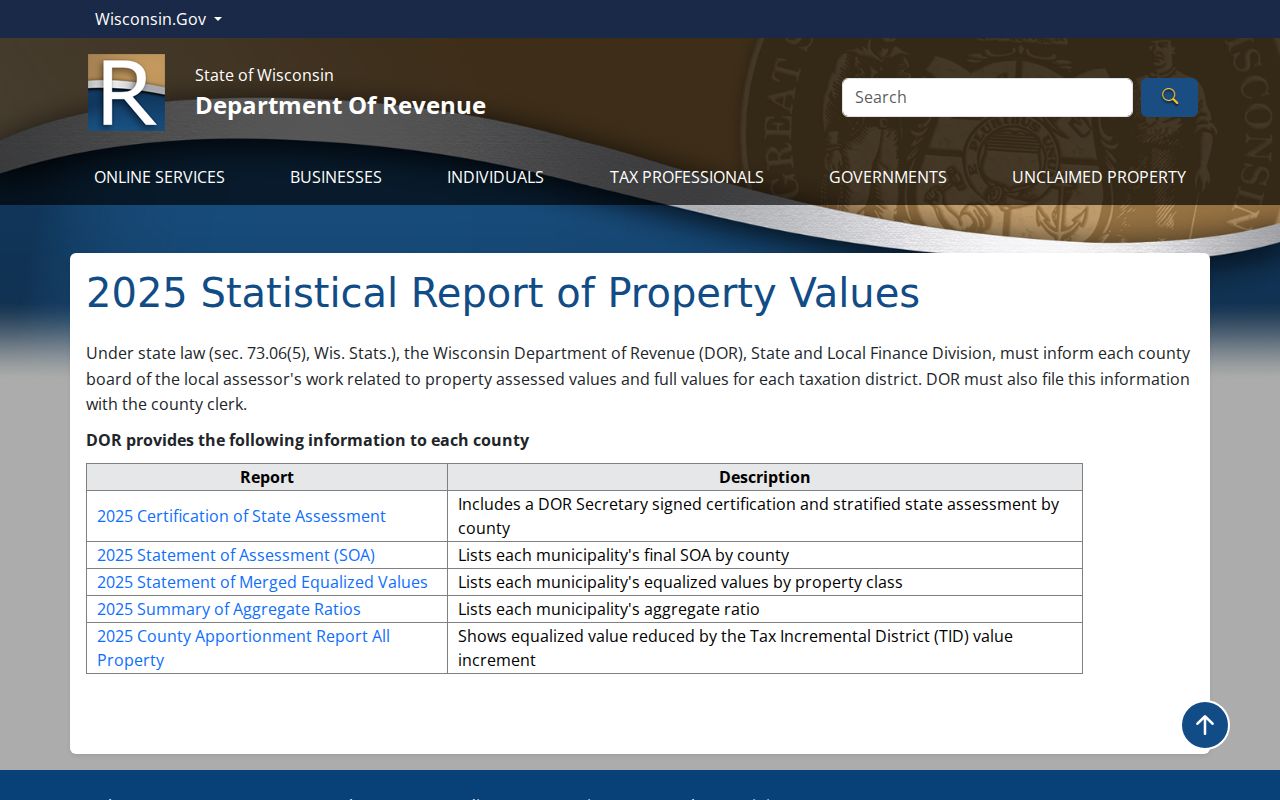
The DOR view helps place a local tax roll in its municipal setting. It does not replace the value field on a parcel record.
Delinquency Can Lead to a Tax Deed
Unpaid property taxes in Marathon County move through two offices. The Treasurer tracks postponed and delinquent real-estate taxes. The County Clerk coordinates tax-deed notices and sales. Before bidding, the county tells bidders to investigate the parcel. Confirm special assessments with the municipal clerk. A 2026 memo listed 89 parcels in in-rem foreclosure. It also listed 41 judgments transferring land to the county, and 43 parcels moving through the tax-deed process. Treat that report as a time-stamped administrative update. It is not a live list of sale properties.
For any single parcel, compare the Ascent tax years and status. Check them against the Treasurer's current delinquency details. Next, search the county's tax-deed notices. Try LandShark for the deed or judgment, WCCA for the case, and Wisconsin Surplus for an active listing. Status shifts constantly. A parcel can be paid, repurchased, appraised, listed, or sold as a batch moves forward. Confirm current status before relying on an old memo. The Marathon County tax-deed page publishes the bidder route and notice links.
Look Up a Marathon County Tax Bill
A Marathon County tax bill lookup starts with the parcel. Find it in Ascent first, and record the municipality, PIN, and tax years. Then use the treasurer channel named on the bill. Confirm the amount due and payment status there. One caution applies. The parcel search identifies the right account. It does not mean the County Treasurer handles routine installments for Wausau.
- Search Ascent by street, owner, municipality, or complete parcel number.
- Open the parcel and write down its municipality, PIN, and listed tax years.
- Follow the current bill to the local treasurer, or to Wausau for its ordinary installments.
- For postponed or delinquent tax, contact the County Treasurer and ask about the parcel's current status.
- Assessed value
- The municipal value assigned to the parcel.
- Mill rate or levy
- Terms used to describe a district's tax rate or revenue need.
- Lottery credit
- A parcel credit field shown by Ascent.
- Tax lien
- A recorded or statutory claim tied to unpaid tax; check the actual record.
Assessment Review Starts Before the Bill
Assessment review in Marathon County begins before any bill arrives. Each municipality sets its own Open Book and Board of Review dates. Those dates come after the second Monday in May. Start with the municipal assessor. Ask for an explanation of the parcel's assessment. If that does not resolve the value issue, the owner must give the municipal clerk notice of intent. That notice is due at least 48 hours before the first Board meeting. The Board may waive notice for good cause or extraordinary circumstances. A written objection is then due within the first two hours of that first meeting.
Timing matters because the December tax statement arrives too late for a current-year objection. Paying under protest is no substitute for a formal one. Keep the local clerk's calendar, since dates differ by municipality. Bring evidence tied to the value itself. A claim that the tax bill is simply high will not carry the day.
Appeal with Parcel-Level Evidence
The strongest evidence starts with a recent sale of the subject property. Recent comparable sales can also support a claim. So can an appraisal witness. Gather the parcel record, sale dates, and property features. Also gather any documentation that explains why a comparison fits. Remember that a municipal assessment ratio is broad context. It does not prove that a single house is overvalued.
When the Board's decision is unfavorable, the county describes a DOR appeal within 20 days after receipt of the decision. An alternative window is 30 days after the clerk's affidavit. The described filing fee is $100. The DOR route carries a $1 million fair-market-value ceiling. A circuit-court appeal must come within 90 days after Board adjournment. It is limited to the record and testimony already presented. Confirm current rules and dates with the clerk before filing.
Challenge a Marathon County Assessment
An assessment objection in Marathon County is time-sensitive and local. Start with a call to the municipal assessor for an informal explanation. If the issue stays unresolved, give the clerk notice at least 48 hours before the first Board meeting, then file the written objection within the first two hours of that meeting. Every municipality keeps its own Open Book and Board calendar. Check with the clerk rather than trusting last year's dates.
Appeal window. A December tax statement is too late for the current-year objection. If a Board decision is appealed, the county describes a 20-day or 30-day DOR deadline based on notice, and a 90-day circuit-court deadline after Board adjournment. Confirm the current calendar and filing rules with the municipal clerk.